

Your Next Audience Is AI: Why Stories Need to Reach People and Platforms
 by Ken Buraker | January 28, 2026
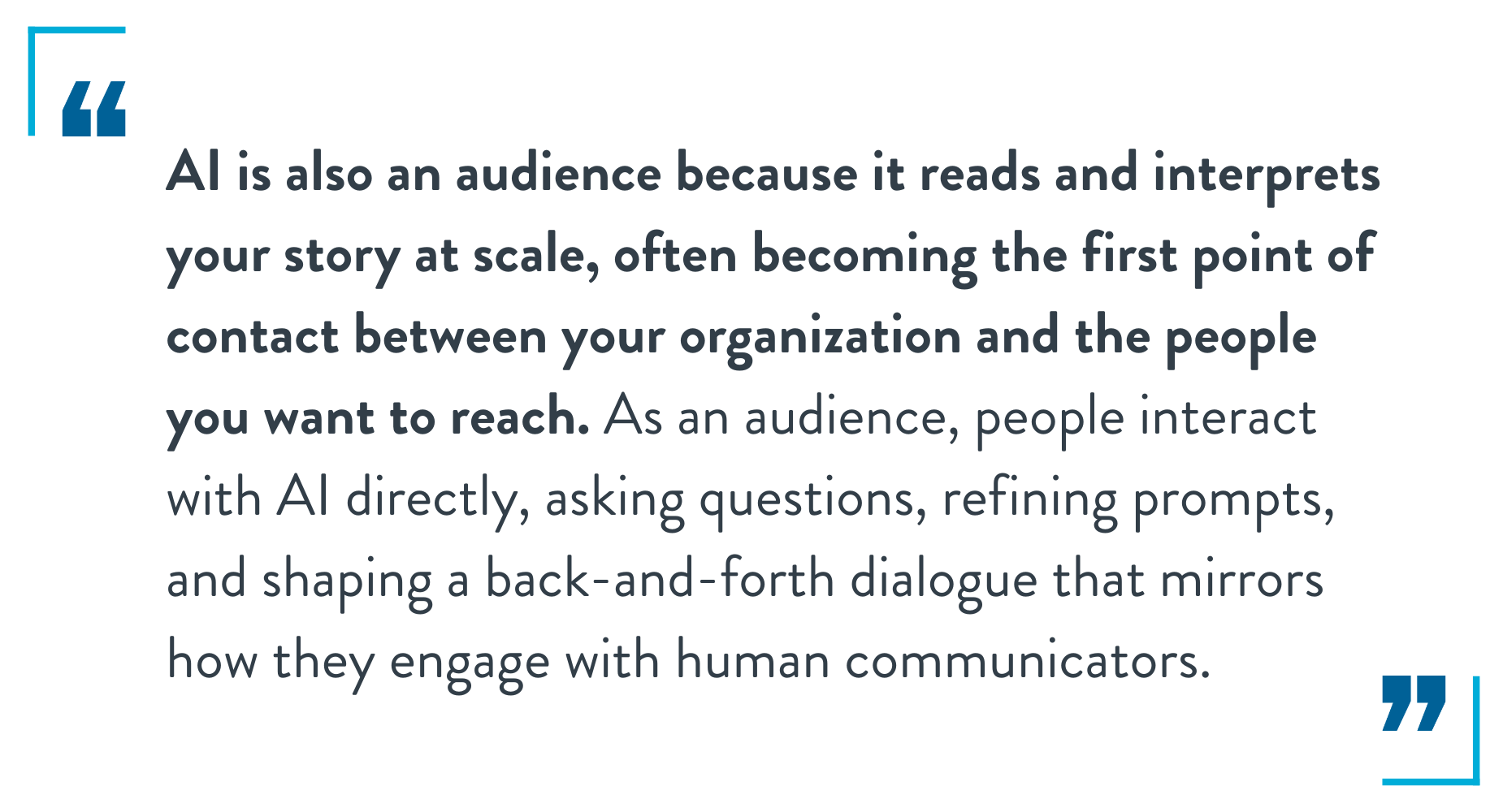
AI is now a primary reader of organizational content, shaping how people discover, understand, and interpret it. To succeed, organizations must balance content that connects with people and content structured for AI systems to interpret accurately. This requires clear narratives, consistent language, structured information, and a renewed focus on human-first storytelling. AI is also an audience because it reads and interprets your story at scale, often becoming the first point of contact between your organization and the people you want to reach. As an audience, people interact with AI directly, asking questions, refining prompts, and shaping a back-and-forth dialogue that mirrors how they engage with human communicators. Earned media plays a critical role in this dynamic. Because AI systems give greater authority to trusted, third-party sources, earned coverage shapes how AI understands an organization before it reads an owned web page.
Table of Contents
- The Shift in How Influence Is Shaped
- Stories That Touch People Still Matter Even in the AI Era
- AI as a New Force of Influence
- Why Earned Media Matters More Than Ever
- The New Communications Approach
- Which Channels and Content Types Should You Prioritize?
- How Do You Measure AI Visibility?
- How Is Your Content Training AI?
- Designing and Creating for People and AI
- How Can You Optimize Written and Visual Content for AI?
- How Is AI Learning to Read Text and Images?
- Where Should You Begin If You’re Starting for the First Time?
- Rethinking Influence for the AI Era
The Shift in How Influence Is Shaped
For 20 years, PR professionals have shaped influence through a media mix including earned media, SEO, SEM, and newswire distribution. These tools helped determine how organizations were discovered and how credibility was established across the digital ecosystem. Today, a new, unprecedented opportunity has entered the mix: AI platforms such as ChatGPT, CoPilot, Gemini, Claude, and Perplexity. AI is not just another tool for influence. It is, by default, a reader and an audience, consuming the content we publish while interpreting it very differently from how people do. So, does that mean we are developing content for machines?
Stories That Touch People Still Matter Even in the AI Era
While AI is a new target, people remain the primary audience. Storytelling should still be rooted in communication that reaches people where they already are, and AI platforms have become one of the places people turn first for understanding. In fact, AI often amplifies whatever resonates with people first, as measured by signals such as the questions users ask, the answers they choose, and the sources they trust over time. This dynamic is shaped by both generative AI, which composes answers from what it has learned, and search-integrated AI, which relies on real-time user behavior and trusted sources to decide what to surface.
Your influence strategy now lives in two places: in the earned and owned networks you build and in the AI systems that retell your story. A consistent brand story and a clear narrative still shape trust. Press releases, blog content, owned content, IRL events, and earned media coverage continue to matter because they help build credibility and give organizations flexibility around channel, targeting, and format. These materials are indexed by AI systems and help form the baseline understanding AI uses to describe your organization.

AI as a New Force of Influence
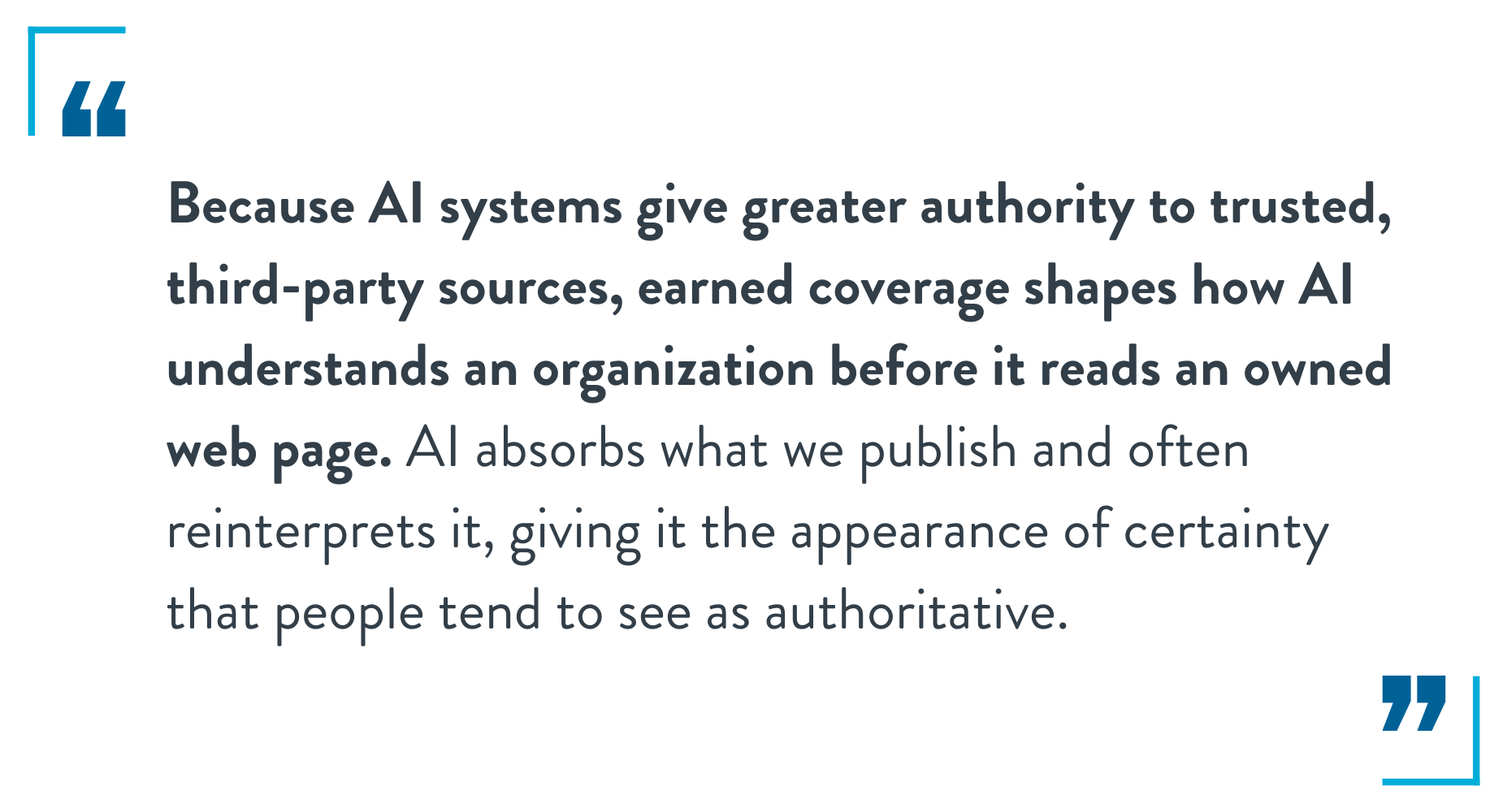
AI is also a new kind of influencer. When people ask AI platforms questions about organizations, industries, or leaders, or even open-ended questions, the responses function like large-scale digital word of mouth. AI absorbs what we publish and often reinterprets it, giving it the appearance of certainty that people tend to see as authoritative. That perceived authority gives it outsized influence. These impressions spread quickly and can shape reputations long before someone visits a website or reads a news story. Bottom line: if your content isn’t part of the AI results, you’re missing out.
Influence grows because of how AI processes information. It connects patterns across everything it can access, amplifying the narratives it can most easily recognize and understand. When information is missing or unclear, AI fills in the gaps with whatever else it can find — and in some cases, that’s where the worry about “hallucinations” can come into play.
These platforms do more than index the web. They synthesize it. They scan enormous amounts of information and create summaries from the strongest patterns they find. The words and visuals we publish now shape how people understand us, and how AI describes us to the world. We are also seeing the rise of AI-based virtual influencers, which shows that AI is not only interpreting content but is also increasingly shaping influence directly.
AI platforms interpret, rank, and restate our work. Influence today is measured not only by what people click but also by what the AI platform says about you. Increasingly, your content must rise high enough in AI summaries to drive action, even purchases, as AI becomes a new interface for commerce.
Why Earned Media Matters More Than Ever
Earned media is critical in this new environment. AI often gives the most authority to information that appears in trusted, independent outlets because these sources signal credibility to both people and AI platforms. That is why earned coverage often rises to the top of AI‑generated summaries.
AI systems often prioritize high-authority, third-party sources when forming summaries. Google’s documentation on Search ranking systems offers one of the clearest public examples of how large platforms prioritize helpful, reliable content, which helps explain why authoritative publishers and credible domains often appear in what people see and what AI systems summarize.1 This happens because journalistic writing tends to be clearer, more direct, and more factual than marketing content, giving AI reliable explanations that are easier for the model to parse and prioritize.
The most influential inputs for AI include:
- Earned media, which AI treats as highly credible, because it reflects third‑party validation.
- High‑authority domains, including .gov, .edu, and long‑established media sites (e.g., The New York Times, Reuters, the BBC, and NPR).
- Wire‑distributed releases, which syndicate your story across reliable outlets and expand your authoritative footprint (e.g., PR Newswire and Business Wire).
- Consistently structured owned content, which reinforces the story AI learns from external sources. On your website, using clear pages, short summaries, and reliable attribution makes your content easier for AI to interpret.
The New Communications Approach
We are now creating for two audiences: people and AI. As an audience, AI interprets stories differently from human readers. AI consumes information by analyzing structure and consistency across our communications. It follows the strongest patterns it can detect rather than reading for meaning, as people do. It looks for clear names, straightforward explanations, and consistent messages so it can understand what we mean and accurately share our story.
That requires a clear approach to how both audiences experience and interpret your story, which is why a dual-track framework matters.
A Dual-Track Communications Framework for Human and AI Visibility
| Track A: Human Storytelling | Track B: AI-Readable Structure |
|---|---|
| Start with the human brief: identify who you need to reach and what they need to understand or do. | Shape the story so AI can follow it through clear headlines, short summaries, and naming that stay the same across pages. |
| Define the core story: who you are, what you do, and why it matters now. | Use question-based headlines and concise context so AI can quickly identify the topic and its relevance. |
| Create earned and owned content that feels natural and credible to people. | Add direct facts and repeated identifiers, so AI does not misread or overlook key information. |
| Publish through trusted sources such as wire services, trade media, and authoritative pages. | Use structured formats that help AI interpret those same materials more reliably. |
| Tell a consistent story across the channels people rely on. | Keep language steady across your site, so AI sees a clear pattern rather than mixed terminology. |
| Periodically review how AI describes you using tools like ChatGPT, Gemini, and Perplexity. | Compare descriptions across platforms and note inaccuracies or gaps. |
| Review your core pages, bios, and summaries on a regular cadence to ensure they stay accurate and aligned. | Update structured sections and summaries so AI continues to reflect the current version of your organization. |
This approach is the new discipline of shaping how AI understands your organization and story.
Pro tip: Using tables helps AI better understand your content. Tables provide a clean structure, clear relationships between ideas, and consistent formatting that AI models can easily consume.
Which Channels and Content Types Should You Prioritize?
AI prioritizes specific channels and content types more than others. These are the places where your story is most often read, summarized, and reused both by people and by AI platforms. This section focuses on the earned and owned assets that most influence visibility.
| Content AI Prioritizes Most | Earned Content | Owned Content |
|---|---|---|
| High-authority sources | Coverage from trusted news outlets, trade media, and industry publications | About pages, mission statements, leadership bios |
| Frequently cited information | Wire-distributed press releases that syndicate across reliable domains | FAQs, fact sheets, program summaries |
| Clear, structured explanations | Expert quotes, op-eds, interviews | Structured pages with clear summaries and consistent naming |
| Clear names and identifiers | Third-party validation and references | Pages with explicit descriptions, timelines, and roles |
| Updated content | Recent stories from credible outlets | Recently updated core pages (About, bios, services) |
The Most Important Channels to Prioritize
These priorities reflect how AI systems weigh authority and credibility when forming summaries.
- Press releases distributed via reputable wire services, when the situation merits a press release
- Your website, especially core pages such as About, leadership bios, and program summaries
- Structured materials with metadata (e.g., FAQs, schema markup, glossaries)
- High authority domains where your brand appears (e.g., government sites, universities, and established media outlets)
If AI cannot find reliable information across these sources, it will fill in the gaps using whatever it can access. For example, if your About page is outdated or unclear, AI may rely on old press releases, third-party commentary, or even competitor descriptions to summarize who you are.
How Do You Measure AI Visibility?
Treating AI as an audience requires ongoing measurement, not one-time optimization. Because AI summaries evolve as new content appears and sources change, organizations should monitor how their story is being interpreted over time.
A practical approach includes:
- Set a review cadence. For most organizations, quarterly reviews are sufficient. High-stakes brands or fast-moving issues may require monthly checks.
- Test with consistent prompts. Ask platforms such as ChatGPT, Gemini, or Perplexity the same set of questions a stakeholder or journalist might ask.
- Track accuracy and framing. Note whether descriptions are correct, which sources are cited, what language is used, and whether competitors appear alongside you.
- Correct at the source. Update core pages, publish clarifying content, or reinforce your narrative through earned media so AI systems pick up the right signals over time.
Measurement closes the loop between human storytelling and AI interpretation, helping organizations maintain credibility and influence as platforms evolve.
How Is Your Content Training AI?
When you publish content online, you are doing more than speaking to readers. Every article, post, or design asset becomes a small piece of data that helps AI learn what is true about your organization. In practical terms, the way you manage and distribute your content now directly shapes how AI understands and represents your organization.
If your story is missing from the public web, AI may fill in the blanks from unreliable sources. But when your materials are consistent and well-structured, they are more likely to be cited and reinforced by AI-generated summaries.
Designing and Creating for People and AI
Images, infographics, and videos should communicate clearly to people while also being properly tagged and described for AI. Visual metadata and structured captions ensure these assets are both discoverable and accurately interpreted by AI.
The best communicators are creating for people and for AI simultaneously. For people, content should feel clear and credible. For LLMs, it should be structured and contextual.
Here are practical ways to do both:
- Anchor your facts. For example, “Founded in 1975, Microsoft develops software and cloud services used by organizations worldwide.” Consistent identifiers help AI accurately connect entities.
- Avoid vague references. AI relies on clarity. Instead of “it helps them,” write “the platform helps state governments.”
- Repeat key names or entities. People see this as an emphasis. AI sees it as precision.
- Keep tone and vocabulary consistent. Familiar phrasing builds a recognizable pattern in your content over time.
When your content reads like a trustworthy source, AI will treat it like one.
How Can You Optimize Written and Visual Content for AI?
Traditional SEO is evolving into what some now call Answer Engine Optimization (AEO), the practice of shaping content for AI-generated answers.
Use these tips on how to adapt:
- Use question-based headlines. AI engines map headlines to prompts.
- Instead of: “Microsoft launches new AI tools.”
- Try: “How is Microsoft expanding access to AI-powered productivity tools?”
- Front-load context. The first 300 words often appear in AI summaries, so make sure the who, what, when, and why appear early.
- Use schema markup for articles, FAQs, and press releases. Structured data increases visibility across search engines and AI pipelines.
- Maintain structured website data. Adding or maintaining structured data, such as JSON-LD scripts, helps AI understand your content better without rewriting it.
- Write short summaries. AI frequently pulls from these when creating concise answers.
- Publish on credible domains. Domain authority still affects both people’s trust and AI weighting.
- Crosslink your content. Internal links strengthen topic connections and brand comprehension.
- Then test your visibility. Ask tools like ChatGPT, Gemini, or Perplexity: “Who are the leading organizations in [your field]?”
If your organization does not appear, your content has not yet reached the AI platforms.
How Is AI Learning to Read Text and Images?
AI no longer stops at words. It can now analyze and summarize images, infographics, and videos. Adding descriptive alt text and rich metadata helps AI classify visual assets and include them in relevant summaries. The most effective optimization connects both written and visual content, creating a unified story that people can see and AI can understand.
Search used to be a primary gateway. We built keyword-heavy pages so people could find them through Google. But now, AI is rapidly becoming the first stop for information rather than a website. Users increasingly receive direct answers generated by models like ChatGPT or Gemini. These tools pull information from across the web and present it instantly, often replacing the need to visit your organization’s website. This shift means that visibility is no longer just about ranking high in search results but about being the content source that AI relies on when composing those summaries.
AI-generated summaries are now a dominant part of how people search and make decisions. According to a 2025 Bain & Company analysis, about 80 percent of search users rely on AI summaries for at least 40 percent of their queries, and roughly 60 percent of searches now end without a click. Search, news, and social platforms are becoming answer engines that interpret information rather than simply list it.2
How Does Content Creation Train AI?
This shift changes what visibility means. It is no longer enough to appear in traditional media channels. The new goal is to appear in the AI summaries that shape what people may see first.
Creating content is both creative and technical. Every piece of work you publish, whether words, visuals, or design, teaches algorithms who you are and what you stand for.
Think of it as teaching AI about your organization through every creative choice you make, from the words you use to the visuals you publish. When a journalist, customer, or policymaker asks an AI about your organization, the answer they receive reflects your published patterns of messaging and design. Being clear and showing up consistently matter as much as being convincing.
How Do People and AI Consume Information Differently?
| People | AI |
|---|---|
| Look for meaning and tone | Look for structure and clarity |
| Understand nuance and context | Prefer direct, explicit statements |
| Respond to visual hierarchy | Respond to organized, well-labeled information |
| Judge credibility through voice and expertise | Judge reliability through consistent patterns |
| Recall the full story | Rebuild meaning from the data you publish |
Communicators today must be both storytellers and data curators, crafting stories that move people while remaining easy for AI to interpret.
Where Should You Begin If You’re Starting for the First Time?
If this is your first time thinking about optimizing your content for AI, start small and build momentum.
- Review your top 10 most important web pages. Make sure the who, what, when, where, and why are clear in the first 2–3 paragraphs.
- Update your About page and mission statement. AI relies on these pages to understand your identity.
- Refresh leadership bios. AI heavily uses these to build context.
- Create short summaries for your major programs, services, or initiatives. AI often pulls from summary-length content.
- Run visibility tests. Ask ChatGPT, Gemini, or Perplexity questions about your organization. Note what is missing.
- Address gaps with simple, structured updates. Even small improvements dramatically increase the accuracy with which AI can describe you.
- Make this a best practice, not a project. AI systems refresh their understanding over time. Your content should evolve the same way.
Before you create, ask yourself:
- Does this help people understand me?
- And does it help AI accurately describe me?
Starting here ensures that AI understands your organization correctly before you invest time in further optimization.
Rethinking Influence for the AI Era
We have rapidly moved from a world of clicks to a world of dual comprehension, where both people and AI interpret and act on what we create.
Your next reader may be an AI preparing an answer for a policymaker, customer, or journalist. If you want that answer to be accurate, you must provide the AI platform with clear, reliable information.
At Curley, we are already helping clients make this shift by building earned media strategies that influence both people and AI systems, ensuring that third-party coverage reinforces the same narrative found on your owned channels. Now, both people and AI rely on earned media to verify credibility. We strengthen their core content and improve how AI interprets and reflects their work.
Our focus is to help organizations appear accurately in AI‑generated summaries and conversations. This work depends on a structure that allows both people and AI to understand who you are and why your work matters, supported by earned stories that add authority and context.
AI amplifies what is already clear and compelling for people. The organizations that succeed in this new era will strengthen both the content AI can interpret accurately and the narratives that connect emotionally with people. We can help your team build future-ready communications and guide you through this evolving landscape. Even as technology evolves, organizations still need narratives that inspire change, drive coverage, and connect with people first.
1 Google Search Central. A Guide to Google Search Ranking Systems. Accessed 2026. https://developers.google.com/search/docs/appearance/ranking-systems-guide
2 Bain & Company. Consumer Reliance on AI Search Results Signals New Era of Marketing. February 2025. https://www.bain.com/about/media-center/press-releases/20252/consumer-reliance-on-ai-search-results-signals-new-era-of-marketing–bain–company-about-80-of-search-users-rely-on-ai-summaries-at-least-40-of-the-time-on-traditional-search-engines-about-60-of