

From Story of Record to Network of Influence
 by Julie Crimmins | March 31, 2026
How to measure who matters in today’s fragmented media landscape
For years, communications teams relied on a familiar shorthand: land the story in the “right” outlet and influence would follow. Big legacy brand. Big audience. Big impact. That shortcut no longer holds.
The latest layoffs at The Washington Post are only the most visible signal of a deeper shift we’ve been tracking for some time. Media isn’t disappearing, it’s fracturing, and influence isn’t evaporating, it’s redistributing. That distinction matters, especially for organizations operating in policy dense, reputation sensitive environments like healthcare, government and regulated industries. The question isn’t whether media still matters, it’s how to identify influence when it no longer lives in one place.
Why does media still matter – even now?
Despite shrinking newsrooms and changing business models, journalism continues to play three critical roles:
1. Agenda-setting: Reporters still shape which issues consumers, policymakers, executives, advocates and investors focus on – and which they ignore.
2. Narrative formation: Media coverage establishes frames that persist long after a headline fades.
3. AI visibility: Increasingly, earned media informs how large language models summarize issues, institutions, and leaders. If your story isn’t present in credible reporting, it’s less likely to surface in AI-generated answers. These influence networks don’t just shape coverage—they increasingly shape how AI systems summarize and surface institutional credibility.
If influence is fragmenting, where is it moving?
Layoffs don’t eliminate influence. We’re seeing experienced reporters migrate to:
• Newer outlets built around policy and power audiences
• Independent newsletters and Substacks with highly engaged, decision maker readerships
• Hybrid “legacy+” models that combine institutional credibility with digital distribution
A recent example: Robert Allbritton has been looking to hire former Washington Post reporters to build out coverage at NOTUS. The brand is newer, but the reporters’ sourcing, judgment, and agenda setting power didn’t disappear with their old masthead.
What’s notable is not just where these reporters land, but how quickly their influence travels with them. Muck Rack’s State of Journalism 2026 report reinforces this dynamic: journalists increasingly operate across multiple platforms at once, extending their reach beyond a single outlet. For communications teams, that makes reporter-level influence far more predictive than outlet reputation alone.
So how should organizations define influence now?
At Curley, we define media influence as the ability of a reporter to shape conversations, executive decision-making, and follow-on coverage across mainstream, trade and policymaker audiences. This definition moves beyond circulation numbers and follower counts. It helps explain why some reporters consistently “punch above their weight” – and why others with large audiences may have limited impact on outcomes that matter.
What actually signals influence?
When we evaluate reporters today, we look across several dimensions.
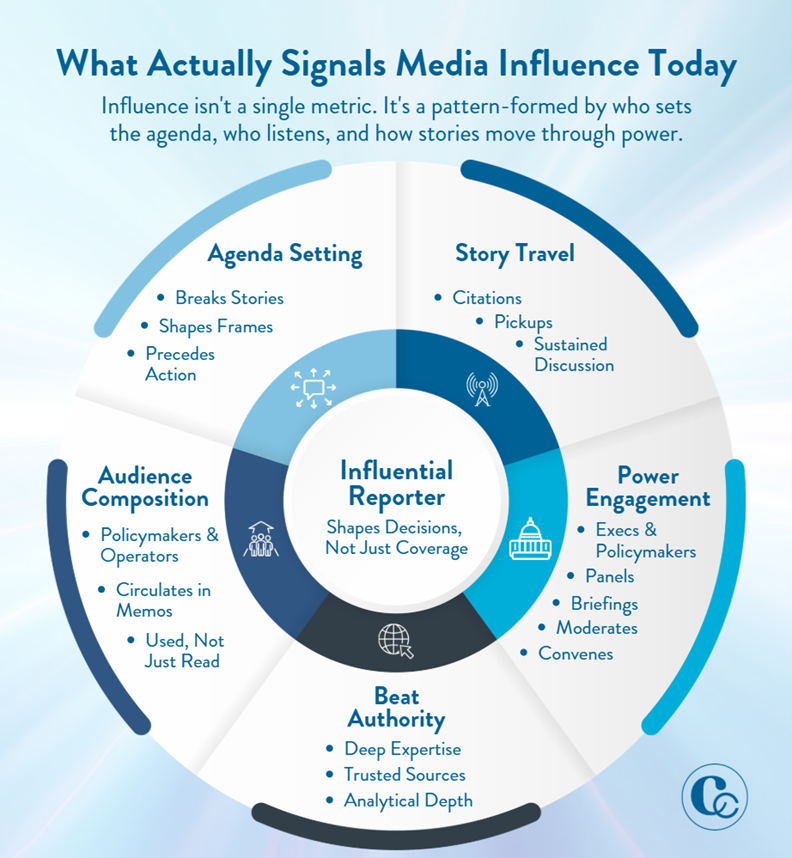
1. Does the reporter set the agenda – or follow it?
Influential reporters don’t cover news moments, they create them.
Signals to watch:
- Regularly breaking stories that others follow or cite
- Introducing new frames or questions into the public conversation
- Coverage that precedes hearings, rulemaking, advocacy pushes, or executive action
- Policymakers or trade groups referencing their reporting directly
2. Who actually reads – and uses – their work?
Audience size matters less than audience composition.
Signals to watch:
- Is this a policy-first, trade, or consumer-facing publication?
- Where does the reporting circulate after publication?
- Does it show up in policy memos, earnings calls, advocacy letters, or internal briefings?
A smaller audience of industry leaders or Hill staffers can be more influential than a broad consumer readership.
3. How deep is their beat authority?
Influence grows with expertise.
Signals to watch:
- Long-term focus on a specific industry or policy area
- Nuanced, explanatory writing rather than surface-level summaries
- Consistent access to senior sources
- Fewer corrections; more investigative or analytical work
4. Does their reporting travel?
Influence compounds when stories move. This is often where local, regional, or trade reporters surprise teams with national pickup power.
Signals to watch:
- Citations by other reporters and outlets
- Follow-on coverage sparked elsewhere
- Inclusion in newsletters, daily briefings, and roundups
- Sustained discussion across platforms, not just a single spike
5. Do people with power engage them?
One of the clearest signals of influence is who shows up.
Signals to watch:
- On-the-record interviews with senior executives and policymakers
- Repeated engagement from the same institutions
- Balanced sourcing across systems, regulators and advocates
- Invitations to moderate panels, brief leaders off the record, or speak at industry events
How should teams think about independent writers and Substack?
Independent newsletters require a different lens – but not a lower bar. When evaluating Substacks:
- Look beyond total subscribers to growth, engagement and niche relevance
- Prioritize writers with clear subject-matter authority and original reporting
- Don’t overlook smaller, highly focused newsletters that align tightly with your issue area
A narrowly targeted healthcare policy Substack with a few thousand engaged readers may be far more valuable than a massive general-interest list that receives hundreds of pitches a week.
The bottom line
Influence today lives in networks, not newsstands. It moves through people as much as platforms. And it rewards teams willing to look past brand shorthand to understand how narratives actually form, travel and land. For organizations that get this right, the opportunity isn’t smaller than it used to be, it’s more precise.